Before & After ZeroAvia: The Unwritten Story of Val Miftakhov

Since the early days of the COVID-19 pandemic, I've been closely following ZeroAvia and its founder, Val Miftakhov.
Hydrogen aviation was, and still is, viewed by many as just theory. While much of the aerospace industry was talking about sustainability in conferences, ZeroAvia was flying hydrogen-electric aircraft. Behind that effort was Valery Miftakhov, a physicist, pilot, entrepreneur, runner, biker, swimmer, family man and relentless builder who had already helped advance the electric vehicle revolution long before turning his attention to aviation.
a man in front of the white house a man in a skim contest a man presenting to a large audience a man in a race a man and his bike Val Miftakhov and Joeben Bevirt John Kerry Val Miftakhov flying
Val Steps Down as ZeroAvia CEO
Then, on May 29, 2026, came unexpected news. Val announced he was stepping down as CEO of ZeroAvia after nearly a decade spent pursuing one of the most ambitious goals in transportation: eliminating fossil fuels from flight. While the announcement was bittersweet for those of us who have followed his journey, it also marked the end of a remarkable chapter and the beginning of another.
ZeroAvia now enters its next phase under the leadership of Christine Ourmières-Widener, one of the most accomplished executives in commercial aviation. With leadership roles at Air France, CityJet, Flybe, TAP Air Portugal, French Bee, and Air Caraïbes, she brings decades of airline operational experience and appears exceptionally well-positioned to guide ZeroAvia through certification, commercialization, and growth in Europe and beyond.
But this article is not about ZeroAvia's future.
It's about the man who started the journey.
Before the flight tests, before the hydrogen fuel cells, before the headlines, before ZeroAvia became one of the most recognizable names in sustainable aviation, there was a young physics student growing up in Siberia during the final years of the Soviet Union. To understand why Val Miftakhov chose to take on one of the hardest decarbonization challenges on Earth, we first have to understand the path that brought him there.
Siberia, Physics, and the End of an Empire
Long before hydrogen-powered aircraft crossed runways in England and California, Val Miftakhov was a young physics student growing up in Siberia during the final years of the Soviet Union.
The world around him was changing rapidly. The Soviet system that had produced generations of scientists, engineers, and mathematicians was unraveling. For many young physicists, the future suddenly looked uncertain. Yet while governments rose and fell, one thing remained constant: the laws of physics.
It was there, thousands of miles from Silicon Valley and decades before ZeroAvia, that Val developed the mindset that would define much of his career. Physics was not about opinions. It was about reality. Problems either had solutions or they didn't. The challenge was finding them.
That curiosity eventually led him to the Moscow Institute of Physics and Technology, one of the most respected technical universities in the world. But the collapse of the Soviet Union had changed the opportunities available to ambitious young scientists. If he wanted to build the future, he would have to go where the future was being built.
And so, in 1997, Val arrived at Princeton University.
For many people, Princeton would have been the destination.
For Val, it was only the beginning.
While pursuing graduate studies in physics, he found himself drawn into another revolution unfolding across America: the rise of the internet. During the height of the dot-com era, he balanced research with entrepreneurship, already experimenting with the idea that would define his future career: solving large problems through technology and execution.
After Princeton came Silicon Valley.
After Silicon Valley came McKinsey.
After McKinsey came Google.
Each stop added another layer to the toolkit.
Physics taught him how the world works.
Consulting taught him how businesses work.
Google taught him how technology scales.
The pieces were quietly falling into place.
Before He Tried to Reinvent Aviation, He Tried to Reinvent the Automobile
Long before ZeroAvia became synonymous with hydrogen-electric flight, Val Miftakhov was obsessed with another transportation challenge.
Cars.
In the early 2000s, electric vehicles were still viewed by many as futuristic curiosities. Tesla was young. Charging infrastructure was almost nonexistent. Most people believed gasoline would remain the dominant transportation fuel for decades to come.
Val saw something different.
As a physicist, the inefficiency of internal combustion engines was impossible to ignore. As a technologist, he could see batteries improving. As an entrepreneur, he recognized that transportation was on the verge of transformation.
In 2010, he founded eMotorWerks in Silicon Valley.
The company's earliest mission was ambitious and surprisingly practical: instead of waiting for manufacturers to electrify transportation, why not convert existing vehicles into electric cars?
At Maker Faire in 2012, surrounded by prototypes, cables, and curious onlookers, Val spoke enthusiastically about a future where electric transportation would become commonplace. Looking back today, many of those predictions appear remarkably prescient.
What stands out is not simply that he believed in electric vehicles. Thousands of people believed in electric vehicles.
Val built them.
He developed conversion systems. He built charging hardware. He created software platforms capable of intelligently managing charging loads across the electrical grid. Rather than focus on a single piece of the puzzle, he worked across the entire ecosystem.
The result was JuiceBox, one of the earliest widely adopted smart charging platforms, and JuiceNet, a network designed to help electric vehicles become active participants in the future energy system.
This was more than a successful startup.
It was proof of concept for a larger philosophy.
Technology only changes the world when it leaves the laboratory.
Ideas matter.
Deployment matters more.
Years later, that same philosophy would become central to ZeroAvia. While others debated what sustainable aviation might look like someday, Val would focus on getting aircraft into the sky as quickly as possible, learning from real flights rather than theoretical studies.
The mindset was already there.
The aircraft simply hadn't arrived yet.
The Pilot's Contradiction
By the mid-2010s, Val Miftakhov had accomplished something few entrepreneurs ever achieve.
His company had grown.
The technology worked.
The market had validated the vision.
And eventually, eMotorWerks was acquired by Enel, one of the world's largest energy companies.
For many founders, this would have been the finish line.
For Val, it became a moment of reflection.
By then, he had spent years helping accelerate the transition to electric transportation. He drove electric vehicles. His home was powered by solar energy. The future he had imagined years earlier was beginning to arrive.
Yet there was one place where the future seemed strangely absent.
The airport.
A licensed pilot himself, Val had spent years flying both helicopters and fixed-wing aircraft. Aviation wasn't simply an industry he studied. It was something he loved.
And every time he climbed into the cockpit, he encountered the same uncomfortable reality.
The cars on the road were becoming electric.
The electrical grid was becoming cleaner.
Renewable energy was scaling.
Yet aviation remained almost entirely dependent on fossil fuels.
The contradiction was impossible to ignore.
For many people, this might have been a passing observation.
For an entrepreneur, observations become questions.
And questions become missions.
Why was aviation lagging behind?
Why had transportation on the ground begun moving toward electrification while flight seemed frozen in time?
And perhaps most importantly:
If humanity could electrify cars, trucks, homes, factories, and power systems, why couldn't it electrify aircraft?
The deeper Val looked, the more he realized aviation wasn't merely another climate challenge.
It was one of the hardest climate challenges on Earth.
Aircraft demanded extraordinary amounts of energy. Batteries that worked beautifully in cars struggled under the weight and range requirements of commercial flight. Sustainable aviation fuels offered incremental improvements but left major questions unanswered. Much of the industry was searching for solutions that didn't yet exist.
For many entrepreneurs, that would have been a reason to look elsewhere.
For Val, it was precisely the reason to lean in.
The harder the problem, the greater the opportunity to create meaningful change.
And so, shortly after the sale of eMotorWerks, a new idea began taking shape.
What if the next transportation revolution wasn't on the road?
What if it was in the sky?
That question would eventually become ZeroAvia.
The Bold Idea That Became ZeroAvia
Every transformative company begins with an idea that sounds unreasonable.
In 2018, Val Miftakhov's latest idea sounded especially unreasonable.
He wanted to eliminate fossil fuels from aviation.
Not offset them.
Not reduce them.
Not make them slightly more efficient.
Eliminate them.
At the time, many of the world's largest aerospace companies were still debating how aviation would ever reach net-zero emissions. Sustainable aviation fuels dominated discussions. Battery-powered aircraft captured headlines. Yet the fundamental challenge remained unchanged.
Airplanes require enormous amounts of energy.
Far more than cars.
Far more than most people realize.
For Val, the answer wasn't hidden in politics or marketing.
It was hidden in physics.
The same scientific mindset that had guided him since his days in Siberia and Princeton led him toward a conclusion that many others had overlooked.
Batteries were improving rapidly, but commercial aviation demanded energy densities that batteries simply could not provide at scale.
Hydrogen, however, was different.
Per unit of weight, hydrogen contained dramatically more energy than even the most advanced batteries. If it could be harnessed safely and efficiently, it offered a path toward something many experts believed was impossible: practical zero-emission flight.
That conviction became ZeroAvia.
Founded in 2018, the company's mission was deceptively simple to describe and incredibly difficult to execute.
Build hydrogen-electric powertrains capable of replacing conventional aircraft engines.
The challenge touched nearly every discipline imaginable.
Physics.
Chemistry.
Electrical engineering.
Mechanical engineering.
Aerospace engineering.
Certification.
Infrastructure.
Fuel production.
Operations.
Regulation.
Virtually every part of aviation would need to evolve.
Yet instead of spending years producing studies and concepts, Val returned to a philosophy that had followed him throughout his career:
Build something.
Test it.
Learn from reality.
Then build again.
Ground tests soon followed.
Then prototypes.
Then flight testing.
And in 2019, something remarkable happened.
A hydrogen-electric aircraft left the ground.

More Than a Startup: Building One of Hydrogen Aviation's Defining Companies
Over the course of nearly a decade, ZeroAvia transformed from an ambitious startup into one of the most recognizable names in sustainable aviation.
The company completed multiple flight test campaigns, developed increasingly powerful hydrogen-electric propulsion systems, established operations in both the United States and the United Kingdom, partnered with major airlines, attracted backing from some of the world's most respected climate and technology investors, and helped move hydrogen aviation from the fringe of aerospace conversations into the mainstream.
Along the way, Val became one of the most recognizable advocates for hydrogen-electric flight anywhere in the world.
His message remained remarkably consistent.
Aviation could be decarbonized.
Hydrogen was not a science experiment.
The future would belong to technologies that could scale.
Most importantly, progress would come from flying real aircraft and solving real-world problems rather than waiting for perfect solutions.
Whether one ultimately agrees with every prediction or not, there is little debate that ZeroAvia helped reshape the conversation around sustainable aviation.
The company forced the industry to think bigger.
And in many ways, that may prove to be one of its most important contributions.
A New Chapter Begins
On May 29, 2026, ZeroAvia announced that Val Miftakhov would step down as Chief Executive Officer while remaining on the company's Board of Directors.
For followers of the company, the news was surprising.
For entrepreneurs, it was a reminder that founders are often builders by nature. Once one mountain has been climbed, another appears on the horizon.
ZeroAvia now moves forward under the leadership of Christine Ourmières-Widener, a highly accomplished aviation executive whose decades of airline leadership experience position her well to guide the company through its next phase of growth and commercialization.
Meanwhile, Val appears to have already begun writing his next chapter.
His LinkedIn profile now references a stealth AI and energy infrastructure startup, offering only a hint of what may come next.
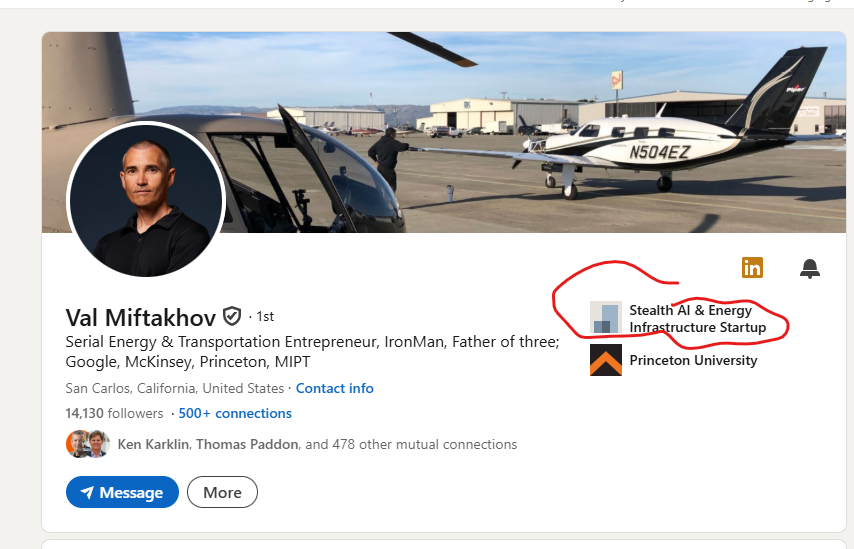
If history is any indication, the industry would be wise to pay attention.
After all, this is the same entrepreneur who helped accelerate electric vehicle adoption before EVs became mainstream and later dedicated years to proving that hydrogen-electric aviation was possible when many considered it unrealistic.
Which brings us to today.
In just a few days, Val Miftakhov will join me on HYSKY Pod for what may be his first long-form interview since stepping down as CEO of ZeroAvia.
We'll discuss the journey that brought him from Siberia to Silicon Valley, from Princeton to hydrogen aviation, from electric vehicles to aircraft, and perhaps even explore what comes next.
Because while one chapter may have ended, the story of Val Miftakhov feels far from finished.
HYSKY Society's Upcoming Interview with Val Miftakhov
For years, I've wanted to sit down with Val Miftakhov and better understand the person behind the mission. Not just the founder who built ZeroAvia. Not just the entrepreneur who helped accelerate the electric vehicle revolution. But the physicist, the pilot, the risk-taker, and the visionary who repeatedly chooses to tackle problems that most people consider impossible.
In just a few days, that conversation will finally happen on HYSKY Pod.
Together on HYKSY Pod, we'll explore the next chapter in Val's story, one that is yet to be written.
Research & Source Materials
The information presented in this article was compiled from publicly available interviews, articles, company announcements, podcasts, videos, social media posts, and biographical materials published between 2010 and 2026. The following sources were consulted in researching the life, career, and entrepreneurial journey of Val Miftakhov.
Princeton Alumni Weekly
The Journey Here: For Val Miftakhov 03, the Sky's the Limit
Published August 27, 2020
My Climate Journey Podcast
Val Miftakhov, Founder & CEO of ZeroAvia
Hosted by Jason Jacobs
Val Miftakhov X (formerly Twitter)
Official Account
Val Miftakhov LinkedIn
Professional Profile
Electric Vehicle Conversion Group (Facebook)
Admin: Val Miftakhov
ZeroAvia
Official Website
ZeroAvia Newsroom
Company Announcements & Press Releases
ADS Advance
ZeroAvia Begins Leadership Transition
Published May 29, 2026
UK Government
Jet Zero Council
Maker Faire 2012
Electric Motor Werks Interview
ZeroAvia YouTube
Tech Talk: Val Miftakhov, ZeroAvia Founder & CEO
Hydrogen Aviation Discussion
Volts Podcast
Volts ϟ April 23, 2025 – Val Miftakhov (What's Up With Hydrogen-Electric Aviation?)
eMotorWerks
Wikipedia Entry
Christine Ourmières-Widener
Wikipedia Entry
Editorial Note
This article was prepared by HYSKY Pod in advance of Val Miftakhov's upcoming appearance on the podcast. It is intended as a biographical profile and historical overview of his career, drawing upon publicly available information and primary source interviews. While every effort has been made to ensure accuracy, readers should note that certain dates, transitions, and contextual details have been reconstructed from publicly available records and may be refined through future interviews and disclosures.
© HYSKY Pod | 2026

