Honoring Mike Hirschberg and His Contributions to Advancing Aviation

Updated: Aug 26, 2025
VFS Executive Director Emeritus forms H2 Advisors and Joins HYSKY Society Board of Directors
By Danielle McLean

Spacetime is fascinating. You feel its pull, you see its effects, even if you don’t always realize it. Picture it like a giant trampoline: drop a bowling ball in the middle, and suddenly there’s a deep curve. Roll a few ping pong balls across, from any direction, and they’ll start to orbit the bowling ball simply because of the bowling ball’s mass, its energy.
That’s what Mike Hirschberg, Vertical Flight Society Executive Director Emeritus, is for me: my center of gravity and the energy that shapes my orbit, though he’s too humble to ever admit it. He doesn’t force or chase; he simply exists with a pull so strong that paths naturally bend around his altruistic visions. And the best part? Sharing that orbit means the co-orbiters around him are some of the most extraordinary people I’ve ever met.
I move like a hummingbird, darting between people, projects, and ideas at a million miles per hour in hopes to bring Advanced Air Mobility to fruition. But no matter where I go or who I talk to, there is always a connection back to Mike. He is the foundation beneath my whirlwind, the steady point around which so much of my career, and indeed the future of vertical flight and hydrogen aviation, has orbited.
Our paths first crossed in 2019 in Atlanta at an Urban Air Mobility conference held at Aviation Week’s MRO America trade. That meeting lit a chain reaction of connections I could never have scripted. Introductions that built the scaffolding of HYSKY itself, opportunities that defined my path, friendships and the mission to decarbonize aviation that shapes who I am today. Always, at the root, there was Mike.
At the end of July of 2025, Mike Hirschberg officially stepped away from the Vertical Flight Society, closing a chapter that influenced much of the trajectory of vertical flight, AAM, and hydrogen aviation. When Mike announced his departure from the VFS after more than 14 years (and over a decade before that as a consultant), the outpouring of support was immediate and overwhelming. More than 500 people across aerospace, government, startups, and academia reacted to his LinkedIn post.
Ken Karklin, CEO of Pivotal, summed up the sentiment simply: “Mike you will be SO MISSED. From everyone at Pivotal, we wish you the very best on your new beginnings!”
Bruce J. Holmes, a longtime NASA strategist and Sr. Consultant at Cerberus Capital Management, reflected: “I have greatly enjoyed our past work together and look forward to the next opportunities.”
Kenneth Swartz, aviation consultant wrote: “You transformed the industry with eVTOL News and connected me with hundreds across the AAM industry. Many thanks!”
After he walked through the office door for the last time, Mike reflected: “Doors, are of course, not only physical but symbolic: ‘When one door closes, another opens.’” The next door? The launch of H2 Advisors, Mike’s next great venture. The name has a clever double meaning: H₂ for hydrogen, the fuel of the future he has championed for years, and H₂ for “Hirschberg Heuristics,” the wisdom and pattern-finding that he brings. Mike’s gift is the ability to see the patterns others miss, to simplify the complex, and to frame challenges in ways that enable progress. In an industry as turbulent as aviation, Mike’s experience in Washington, his network across AAM and defense, and his ability to convene leaders to solve tough problems, makes H2 Advisors a valuable strategic consultancy.
I speak from experience, because Mike has given me the greatest blessing I could have hoped for. When I joined VFS in 2021, I quickly saw that he was firm, principled, and even a bit intimidating. But I respected him so much that I studied his every move and, without realizing it, learned how to be a better leader. Over time, that pedestal became a partnership. When I learned of his VFS departure, I asked him to join the HYSKY Board of Directors. He said yes. In that moment, I felt the full circle of my journey: the person who once inspired me to take the leap into AAM now standing beside me as part of HYSKY’s leadership. It’s a gift not just to me, but to everyone who will be lifted by his guidance.
At the heart of vertical flight, hydrogen aviation, and the future of aerospace is Mike holding together the constellation of people and ideas redefining flight. How did one man become such a force? That’s the story I want to tell.
Origins: The Spark of Flight
Before Mike Hirschberg became the gravitational force of an industry, he was just a kid staring up at the sky.

He grew up in Woodbridge, Virginia, in a household that knew resilience. His parents split when he was nine, and his mother raised four children as a single mom, working nights to keep them afloat. In that environment, Mike, the second oldest, absorbed something deeper than discipline. He learned service, humility, and the quiet strength of those who work tirelessly in the background. It’s no wonder he would later embody those same qualities in aerospace.
The nearby capital, Washington, D.C., was its own classroom. The National Air and Space Museum had just opened in 1976, and while others might have gone to art galleries or monuments, Mike only wanted to walk beneath the rockets and airplanes suspended in that cathedral of engineering. He remembers Skylab vividly, especially the drama of its fiery fall to Earth in July 1979 on his birthday. That cosmic coincidence bound him to the space age forever.
By the time the Space Shuttle program began to stir, Mike knew he wanted to be an aerospace engineer. The Challenger explosion in 1986, a moment of national heartbreak, could have discouraged him but instead he felt a call to make flight safer, better, and more inspiring. Later that year during a family summer vacation trip to Florida, Mike visited the Kennedy Space Center and the dream came alive. He was able to see the exhibit of NASA rocket engines and was hooked. By fall, he was off to college to study aerospace engineering.

At the University of Virginia, he turned inspiration into action. His senior thesis wasn’t a paper gathering dust. He designed and constructed a series of small solid rocket motors, packed by hand, tested on a stand he built himself. He graduated with all ten fingers intact and a lifelong obsession with propulsion.
Mentors lit his path. Professor George Matthews gave him confidence in engineering when confidence didn’t come easily. Later, he would work with Hal Andrews, a retired Navy engineer who had touched nearly every vertical flight program of his era. Hal was a sage, remembered by colleagues with this simple truth:
“Hal loved airplanes, but his true love was helping people. And he seemed to help everyone.”
That sentiment sank into Mike’s bones. If there is one phrase that captures how Mike hopes to be remembered, it is that.
In fact, Mike’s final presentation as Vertical Flight Society staff was titled “A Humble Public Servant: Hal Andrews (1924–2007),” a heartfelt tribute to the mentor who shaped so much of naval aviation history.

Transformation & Mission: From Engineer to Visionary
Mike’s professional story began in government and industry working on rocket motors, but after two layoffs, he found himself working for a non-profit consultancy in the Pentagon, initially on the F-22 fighter aircraft and its advanced engine. He transferred to the Joint Strike Fighter (JSF) Program Office in 1994, where he supported the propulsion systems for the X-32 and X-35 aircraft that combined vertical flight and the speed and range of fighter/attack aircraft. For seven years, Mike lived at the intersection of engineering rigor and national ambition.
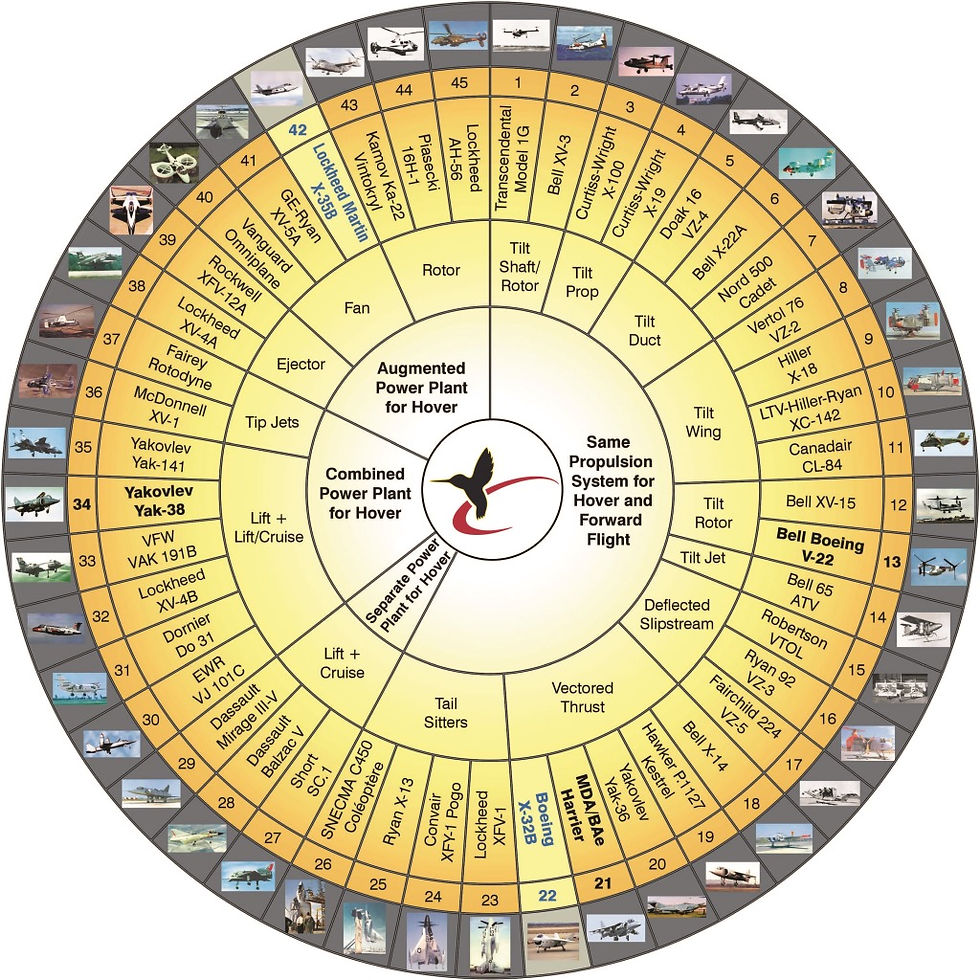
In 1997, Mike wrote an in-depth article on vertical and/or short takeoff and landing (V/STOL) aircraft, which was published with an updated version of the “V/STOL Wheel” for the JSF Program Office. It was published in Vertiflite magazine, the flagship publication of the American Helicopter Society (AHS). It was so well-received that the Society’s leadership urged him to keep writing, and he was made its Managing Editor in 1999.
Mike also spent more than a decade at CENTRA Technology (now part of Amentum) as a principal aerospace engineer. At CENTRA, Mike advised DARPA and the Office of Naval Research on advanced aircraft and rotorcraft concepts.
Mike continued as Managing Editor of Vertiflite, a role that began as a side gig, but in 2011, he became Executive Director of AHS. By then, he had already been writing, editing, and amplifying vertical flight for more than a decade, making him the perfect fit. What set him apart was his ability to translate the language of engineers into stories that inspired an entire community.
It was at AHS that Mike’s true transformation began. Helicopters alone could no longer capture the future. New propulsion systems, advanced rotorcraft configurations, distributed electric propulsion, and the first glimmers of eVTOL were emerging.
Mike made a bold move in 2018 — which, after much consideration, was unanimously supported by the AHS Board — to officially change the name of AHS to the Vertical Flight Society (VFS). It was a declaration: the future of vertical flight belonged to more than helicopters. It included tiltrotors, electric aircraft, hydrogen propulsion, drones, and technologies yet to be invented.
With this transformation, Mike positioned VFS as the convening power of an industry on the brink of revolution.
Breakthroughs: The eVTOL Revolution
If there’s one moment where the future of flight cracked open, it was 2014. Mike Hirschberg, then just three years into leading the Society, organized a gathering with a name so long it sounded like a spell:
“Transformative Vertical Flight Concepts Joint Workshop on Enabling New Flight Concepts through Novel Propulsion and Energy Architectures.”
It was a mouthful, but also a prophecy. In a borrowed conference room capped at 100 people, the seeds of an industry were sown.
Mark Moore, then at NASA and the visionary who would later become Director of Aviation at Uber and now leads Whisper Aero, was one of the organizers. Eric Allison attended, whose career includes CEO of Zee Aero (which later became Wisk), Head of Uber Elevate and Chief Product Officer at Joby Aviation. JoeBen Bevirt, founder and CEO of Joby, shared his early vision for electric vertical flight. John Piasecki of Piasecki Aircraft brought his trademark outside-the-box thinking. Experts from NASA, DARPA and other government agencies attended. Bud Skriba, the self-proclaimed godfather of hydrogen aviation, was there repeating, “hydrogen, hydrogen, hydrogen.”

Mike saw the confluence of technologies: rapidly improving batteries, democratized computational modeling, the FAA updating regulations, and venture capital beginning to flow into “flying cars.” This “TVF” meeting was the world’s first eVTOL conference. By 2016, VFS had started the first eVTOL newsletter. By 2017, the first eVTOL website. By 2018, the first eVTOL short course. Under his leadership, VFS became the revolution’s beating heart.
Membership swelled. Students, engineers, and companies that had once looked at helicopters as niche products suddenly saw themselves as part of something bigger: the future of mobility itself. By 2021, corporate membership had nearly tripled, and individual membership reached 6,500 worldwide.

What began as 100 people in a borrowed conference room became thousands of engineers, entrepreneurs, and dreamers bound together under one banner: vertical flight, reimagined.

Hydrogen: From Whisper to Movement
At that 2014 workshop, Bud Skriba was already championing hydrogen while most were focused on batteries or hybrid-electric propulsion, But Mike didn’t dismiss Bud. He kept that seed alive, knowing that sometimes the wildest ideas simply need time to germinate.
Fast forward six years. The world is shutting down. It’s April 2020, the Covid-19 pandemic has sent everyone home, and the U.S. Air Force launches Agility Prime, a bold experiment to accelerate advanced air mobility. Colonel Nathan Diller, the program’s architect, was determined to show that government could nurture innovation.
Mike was invited to give a kickoff talk. And in that virtual hall filled with Air Force officers, students, engineers, and entrepreneurs, he spoke about Bud’s vision: hydrogen.
That single mention lit a spark for me. I texted Mike mid-talk, phone buzzing next to his computer, wanting to know: “Who is this Bud? I need to meet him.” It was the beginning of a thread that would weave HYSKY, hydrogen aviation, and Mike’s own legacy together.
By May 2020, what began as Bud’s lonely hydrogen persistence became the seed for the H2eVTOL Council, co-founded by Mike, Professor Anubhav Datta of the University of Maryland, Michael Dyment of NEXA Capital, and me. For the first time, the scattered pioneers of hydrogen aviation had a place to gather.
The Council’s momentum quickly grew. In January 2021, it was formalized. By 2022, the first H2-Aero Symposium took place in Long Beach, CA. With masks just coming off after the COVID Omicron surge, the pent-up energy was electric. More than 100 people came in person and dozens more joined online. A 40-page white paper, Multimodal Hydrogen Airport Hub, came out of the symposium and became a blueprint for hydrogen airport hubs.

That white paper birthed what’s now the SAE AE-5H Hydrogen Airport Committee, a formal standards body that is tackling the tough challenges of hydrogen aircraft fueling and safety.
Meanwhile, I took the spirit of the H2eVTOL Council and carried it forward, spinning it into something new: HYSKY Society. While VFS remained focused on vertical flight and hydrogen aviation standards, HYSKY became North America’s first nonprofit dedicated solely to advancing hydrogen aviation through education.
Mike was there at every step as a supporter, partner, co-architect, and believer. The one person who always listened to Bud’s ideas before they were popular now helped amplify them into a global movement.
Hydrogen was no longer a “maybe in ten years” idea. Under Mike’s guidance, it was becoming the most promising path to zero-emission flight.
Mike Hirschberg's Achievements & Advocacy: Building the Sky’s Future
Mike’s legacy can also be found across just about every major milestone where vertical flight progressed.
Take Future Vertical Lift (FVL), what began as a 2008 Congressional mandate risked dying on the vine in Pentagon bureaucracy. Mike and VFS helped transform it into a real program of record, fueling the birth of the world’s most advanced rotorcraft. Today, the Army is moving forward with the Bell MV-75 Valor tiltrotor, a generational leap forward that traces back to Mike’s steady advocacy beginning in 2011.
Or consider the quiet but vital battle for single-engine IFR approval. In 2014, VFS and partner associations like VAI, GAMA, and AEA pushed for the ability of single-engine helicopters to fly under instrument flight rules (IFR). Mike convened the right people and led a pivotal 2017 meeting with the FAA that broke a logjam. In 2019, the Leonardo TH-119 and Bell 407GXi single-engine helicopters were both certified for IFR operations.
Noise, too, weighed on communities and threatened the industry’s social license to operate. Mike conceived of the iFlyQuiet initiative that was adopted by the FAA, raising visibility for “Fly Neighborly” procedures and championing acoustic research. He saw the human environment they inhabited and fought to make vertical flight a good neighbor.
Education was another pillar. Under his leadership, Vertical Flight Foundation scholarship funding nearly tripled, from $35,000 in 2011 to $100,000 annually. He created student competitions, drone challenges, and short courses that brought in the next generation.

The Network: A Living Legacy
Just about anywhere you look in vertical flight, eVTOL, or hydrogen aviation, Mike’s influence is there. From my perspective, it sometimes feels like he singlehandedly launched the entire advanced air mobility industry though he’d never claim it. What he really did was act as a catalyst, the center of gravity around which so many orbits aligned.
For me, it meant introductions that laid the very beams of HYSKY’s foundation: Ben Marcus, who connected me to Dr. Martine Rothblatt, and Dr. Rishav Shrestha, whose journey from GoFly competitor and VFS member led him to stand beside me as HYSKY’s cofounder.
For others, it meant supporting Anubhav Datta’s rotorcraft research, putting Alaka’i Technologies on the cover of Vertiflite, backing Michael Dyment’s infrastructure work, championing Jesse Schneider as SAE AE-5H took shape, and inspiring students like Mrinalgouda Patil, whose famous hydrogen energy-density vs. specific-energy chart showed that “hydrogen is a game changer for vertical flight” and who is now part of Joby Aviation’s team.

Closing Reflections
Mike once said that during his 12 years as the VFS Executive Director,
“I’ve helped transform the vertical flight industry and it has transformed me.”
Like his mentor Hal Andrews transformed his career, Mike has transformed mine. And I can’t wait to see where the path he’s shaping takes the industry next.
Honors & Awards
Honorary Fellow, Vertical Flight Society (2025)
Fellow, American Institute of Aeronautics & Astronautics (2024)
Exceptional Public Service Medal for Aeronautics, National Aeronautics and Space Administration (2023)
Excellence in Communications Award, Helicopter Association International (2015)
Fellow, Royal Aeronautical Society (2012)
Sustained Service Award, American Institute of Aeronautics & Astronautics (2010)
Forest R. McFarland Award, SAE International (2007)
Special Service Award, American Institute of Aeronautics & Astronautics (2006)
Marvin S. Demler Award, AIAA National Capital Section (2000)
Special Achievement Award for Group Accomplishments, NASA (1992)
Leave a comment and tell me a story about you and Mike Hirschberg! - Danielle McLean